Influencer Budgets in Romania 2026: Formulas, Arguments, and Channel Mix

Influencer Budgets in Romania are currently sparking heated debates!
Whenever money is involved in any industry, passions rise and opinions diverge. On social media, these discussions are even more intense!
Short answer: Influencer Budgets in Romania in 2026 range from €60-€150 per Instagram post for nano creators to €3,000-€20,000+ for celebrities. YouTube long-form runs at a 2-3x premium, exclusivity and Usage Rights add 30-50%+, and Q4 fees rise by 20-60%. Full benchmarks and our pricing framework below.
Published: 21 January 2026 | Updated: 11 August 2026
This article does not aim to offer absolute, final solutions… because those simply do not exist in Influencer Marketing. However, we do aim to bring structure and a bit of clarity.
When discussing Influencer Budgets, we have moved past the “guessing” stage and reached rigorous planning based on objectives, audiences, and channels. Although we do not yet have universal standards for every situation, we have the experience and statistics to get us closer to the truth.
In 2026, the pressure for efficiency demands transparency: clear unit costs (CPM, CPE, CPV), clear ad licenses (usage rights), and careful selection of creators. Local micro-strategies (city, interest, generation) can outperform massive investments when planned for every stage of the marketing funnel.
This article synthesises discussions and data from the MOCAPP Webinar in December 2025, turning our team’s recommendations into actionable steps for you.
You will find calculation models for Romanian Influencer Budgets: percentage of digital spend, funnel objectives (awareness, consideration, conversion), and unit costs per format (Story, Reel, TikTok video, YouTube long-video). We also add 2026 benchmarks by segment (nano/micro/mid/macro/mega) and channel (Instagram, TikTok, YouTube), plus seasonality and packages.
The goal of this article is predictability, operational speed, and measurable results in Influencer Marketing.
Context 2026: What influences Influencer Budgets in Romania?
We often receive this question: “How are these Influencer Marketing budgets decided? Why do influencers – from micro influencers, content creators, experts, to celebrities – charge the fees they do?”
There are no fixed formulas; it is a science… but also an art. That is why many clients ask us for the reasons and arguments behind these fees. Especially when, at first glance, two creators seem similar: same community size, same industry, same niche, etc.
Yes, sometimes influencers set fees randomly! However, we believe it is essential for marketing experts (from brands, online shops, agencies) to understand the variables and reasons behind these fees.
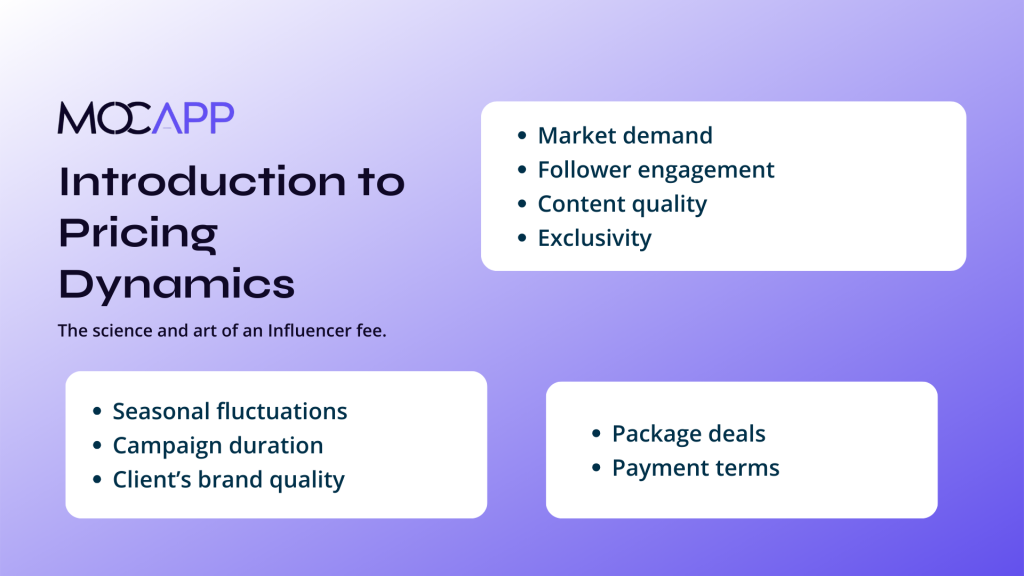
The 9 most common arguments for establishing Influencer fees and budgets in Romania:
1. Market Demand: Supply and demand.
How high is the demand for that specific influencer or creator during that period? If demand is high, the fee will be higher than that of similar creators. It is a basic rule of economics!
2. Engagement.
For creators and influencers who have a higher ER (engagement rate) than others, fees are usually higher.
3. Content Quality.
If the influencer believes they deliver superior quality compared to other creators, the fee will be higher. We see situations in the Romanian industry where creators with 50k-60k followers ask for (and receive!) fees 2x-3x higher than creators with over 100k followers! Better quality often comes from investing in equipment and a team, so the influencer will charge more to cover these expenses.
4. Exclusivity.
When a client requests exclusivity for their niche or industry, the influencer is blocked for a period of time (3-6 months) and cannot earn from competitor brands. For this reason, influencers charge higher fees to cover this “opportunity cost.” There is also the concept of “Implicit Exclusivity” – where exclusivity is not contractually requested by the client, but the influencer realises they cannot work with the client’s competition simply because they do not want to. In this case, the blockage is not imposed by the client, but it is real!
5. Seasonality.
Depending on the industry and niche, supply, demand, and impact fluctuate by season. For example, Fitness and Nutrition campaigns have a greater impact in January and February. Influencers aware of this seasonality will ask for higher fees during those seasons, or they may be more flexible during slower periods.
Tip: To protect yourself from seasonal fluctuations, the MOCAPP team recommends contracting influencers and content creators well in advance – at least 6 months, preferably 12 months. This locks in the fees early, so you avoid price surprises when you are in a rush!
6. Campaign Duration.
It goes without saying that the length of the campaign can influence fees. Our experience shows that influencers prefer long-term relationships with their favourite brands; therefore, they are more flexible when negotiating budgets.
7. Brand Reputation.
Influencers will be more flexible with budgets and fees for a brand that is just starting out or is strictly local. Conversely, when receiving offers from international or highly famous brands, creators may increase fees for the same deliverables/posts. However, this is not a set rule; sometimes influencers think the opposite: because they want to associate with famous brands, they will offer lower fees than the standard rate! Whatever the reasons, be prepared to see different fees depending on the brand’s reputation.
8. Larger Packages.
For larger packages, influencers and their managers may be willing to offer a lower fee per deliverable. For example: 2 Reels and 6 Stories, instead of 1 Reel and 3 Stories.
9. Payment Terms.
If you are open to paying quickly (i.e. within 7 days, or up to 15 days after campaign completion), influencers will be more flexible in offering lower fees. If you are stuck with 60-90-day payment terms, expect higher fees or greater inflexibility during negotiations.
More info about the Romanian Influencer Marketing industry here.
Influencer Fees and Budgets by Social Network
Differences in influencer campaign budgets are also clear when we look at specific social channels, such as Instagram, TikTok, Facebook, YouTube, and LinkedIn. Read more about the Influencer Marketing campaigns in Romania here – https://mocapp.net/blog/influencer-marketing-in-romania-europe-us-2025/
Clients sometimes ask why the same video has different fees on Instagram versus TikTok. The product is the same, and the effort is the same! However, influencers charge different fees because their communities vary by platform, with different reach and engagement levels.
Sometimes, influencers even offer a “dumping price” (an extremely low fee) for a specific social channel to encourage the client to use it, hoping to grow their community there as well.
Influencer Fees in Romania 2026: Benchmarks by Segment
| Segment | Followers | Average fee / post (2026) | When it’s worth it (objective) | Best for | Watch out for |
|---|---|---|---|---|---|
| Nano | 1k-10k | €60-150 | quick testing, local communities, brand authenticity | local conversion, authentic UGC, niches | volume (you need more creators) |
| Micro | 10k-50k | €150-450 | performance + niche awareness, recurring campaigns | conversion, recommendations, trust | tracking (UTM/promo code) + a clear brief |
| Mid-tier | 50k-250k | €450-1,800 | awareness + engagement, mid-scale launches | reach + credibility, funnel mix | large fee differences between creators (negotiate) |
| Macro | 250k-1M | €800-4,500 | national launches, fast large-scale reach | national awareness | UR/exclusivity can increase the cost by 30-50% |
| Mega / Celebrities | 1M+ | €3,000-20,000+ | media impact, a brand “moment” | mass awareness | lower ER + not always cost-efficient |
Note: Exclusivity (3-6 months) and Usage Rights (UR) for Ads can increase costs by 30-50%+. In Q4 (Black Friday/Christmas), fees typically go up by 20-60%.
Source: MOCAPP campaign and negotiation data, Romania, 2025-2026. Benchmarks represent observed ranges and not fixed market rates.
The segment table above estimates baseline organic deliverable fees. The framework below is different: it shows how creator quality, commercial proof and commitment can change the structure and total value of a partnership.
How to estimate an Influencer Marketing budget
Budget method 1: percentage of digital spend
Influencer Marketing Budget = Total Digital Marketing Budget × Recommended IM Allocation
Budget method 2: deliverable planning
Campaign Budget = Number of Creators × Average Deliverables × Average Fee + Usage Rights + Management
Budget method 3: KPI-based
Budget = Target Impressions / 1,000 × Target CPM
Channel mix
| Channel | Primary Role | Typical Format | Cost Tendency | Best Funnel Role |
|---|---|---|---|---|
| Trust, visual storytelling and community building | Reels, Stories, Carousels | Medium | Awareness + Consideration | |
| TikTok | Discovery, reach and cultural relevance | Native short-form video | Low to Medium | Awareness + Consideration |
| YouTube | Depth, education and high-intent content | Integrations, dedicated videos, Shorts | High | Consideration + Conversion |
| Older audiences, community reach and amplification | Video, Posts, Reels | Low to Medium | Awareness + Retargeting support | |
| B2B authority, professional influence and thought leadership | Posts, Articles, Video | Variable | Consideration + Lead Generation |
Pricing framework: turning verification into fees
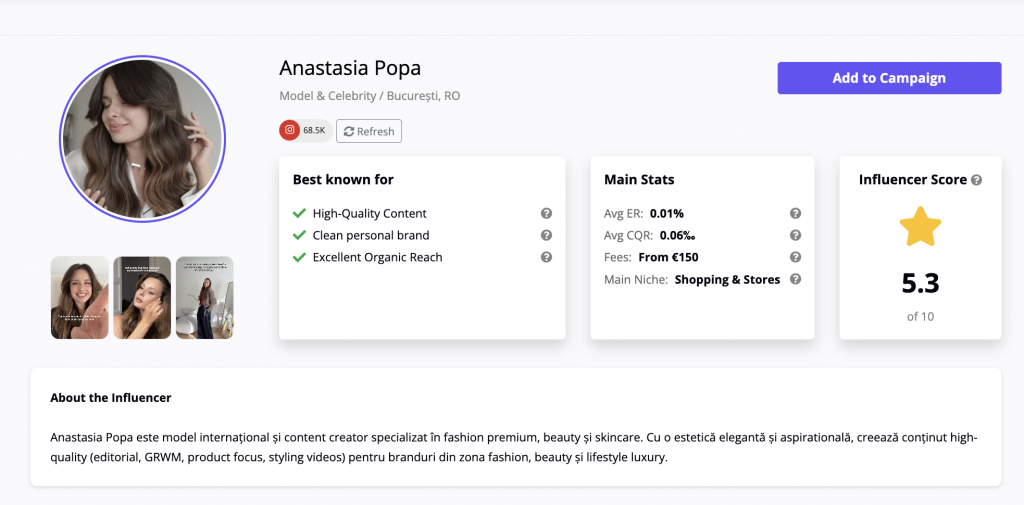
A question we hear after every budget discussion: the creator looks right, so what is a fair fee? Here is the framework we use at MOCAPP.
Score each creator from 0 to 4: one point for each verification they pass. The four checks: audience (authentic, predominantly Romanian), engagement (real ER at or above the segment benchmark), conversion (proof from past campaigns: promo codes, UTM links, affiliate data), and brand fit (content history, brand safety, no recent competitor deals).
Score each creator from 0 to 4, awarding one point when sufficient evidence exists for each dimension. The overall score should not be treated as a binary accept/reject verdict: it determines the appropriate deal structure and level of commercial risk.
| Score | Deal structure | Flat fee (DTC / eCommerce, 100K-500K creator) | Commitment |
|---|---|---|---|
| 4/4 strong | Premium partnership | €1,500-€6,000 + commission/performance bonus | 3-6 months |
| 3/4 strong | Standard deal | €400-€1,500 + commission | 1 campaign + option |
| 2/4 strong | Performance test | €200-€500 + commission | 1 campaign |
| 0-1/4 strong | Pass | N/A | Keep looking |
Ranges vary by niche. These are Instagram rates: YouTube long-form typically commands a 2-3x premium. Apply the exclusivity, Usage Rights and Q4 adjustments from the table above.
When this framework does not apply:
- Awareness campaigns. Conversion (check 3) is not the gate. Measure reach, earned media value (EMV) and brand lift. Checks 1-2 still apply.
- Luxury and high-consideration products. Conversion thresholds halve. Measure 90-day attributed revenue, not 24-hour promo code redemption.
- B2B creators (LinkedIn). Replace audience demographics with firmographics: role, company size, industry. Replace conversion rate with MQL rate.
Framework adapted from the Influencer Strategists article from April 2026 – author Djanan Kasumovic, with fees adjusted to the Romanian market based on MOCAPP campaign data.
Webinar Recording hosted by Florin Grozea (CEO MOCAPP) and Delia Bodea (New Business MOCAPP) – Romanian Influencer Budgets
Here is the full video recording of the discussion on Correct Influencer Marketing Budgets, including the presentation and the Q&A session from December 2025:
FAQ: Influencer Budgets in Romania
How much do influencers charge in Romania in 2026?
Average fees per Instagram post: nano creators (1k-10k followers) €60-150, micro (10k-50k) €150-450, mid-tier (50k-250k) €450-1,800, macro (250k-1M) €800-4,500, mega and celebrities (1M+) €3,000-20,000+. YouTube long-form typically commands a 2-3x premium over Instagram.
How do you set a fair Influencer Budget for a campaign?
Score each creator from 0 to 4: one point each for audience, engagement, conversion proof and brand fit. A 4/4 creator justifies a premium partnership of €1,500-6,000 plus a performance bonus, a 3/4 creator a standard deal of €400-1,500 plus commission, and a 2/4 creator a paid test of €200-500. Below that, keep looking.
Why do two similar influencers charge different fees?
Nine variables move influencer fees in Romania: market demand, engagement rate, content quality, exclusivity, seasonality, campaign duration, brand reputation, package size and payment terms. Creators with 50k-60k followers sometimes charge 2-3x more than creators with over 100k followers, and the market accepts it when quality and demand support the fee.
How much do exclusivity and Usage Rights add to influencer costs?
Exclusivity for 3-6 months and Usage Rights for ads typically increase fees by 30-50% or more: the creator is blocked from competitor deals and the brand extends how the content is used. In Q4 (Black Friday and Christmas), fees rise by another 20-60% due to seasonal demand.
Which social network is the most expensive for influencer campaigns?
YouTube long-form, at typically 2-3x Instagram rates. The same video can have different fees on Instagram versus TikTok because the creator’s community, reach and engagement differ per platform. Some creators even offer lower fees on a channel where they want to grow their community.
Next steps
Planning an influencer budget in Romania?
Create a free MOCAPP account and see full data for 7,500+ content creators, influencers, artists, actors and celebrities in 27 niches. If you would rather start with a conversation about the right budget for your next campaign, book a call with our team.